

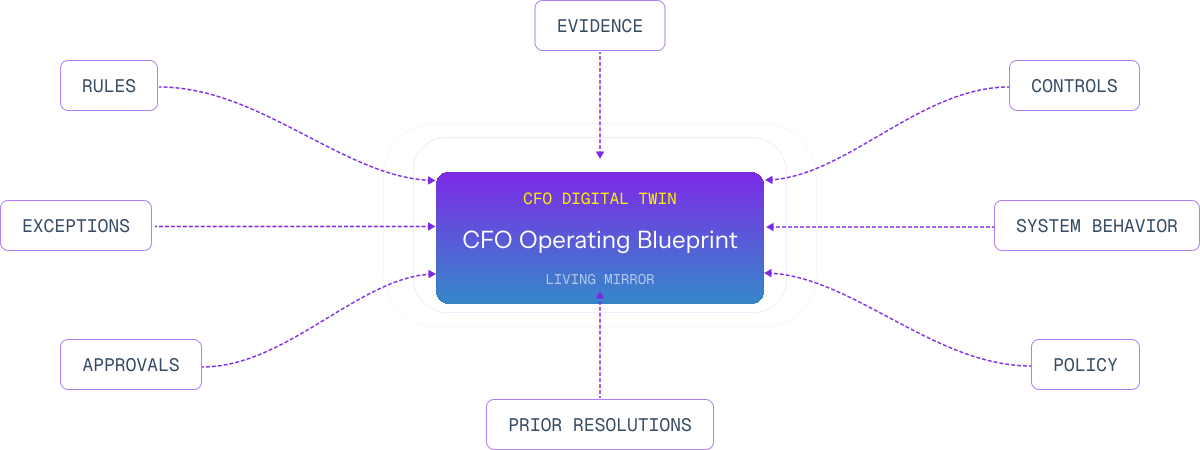
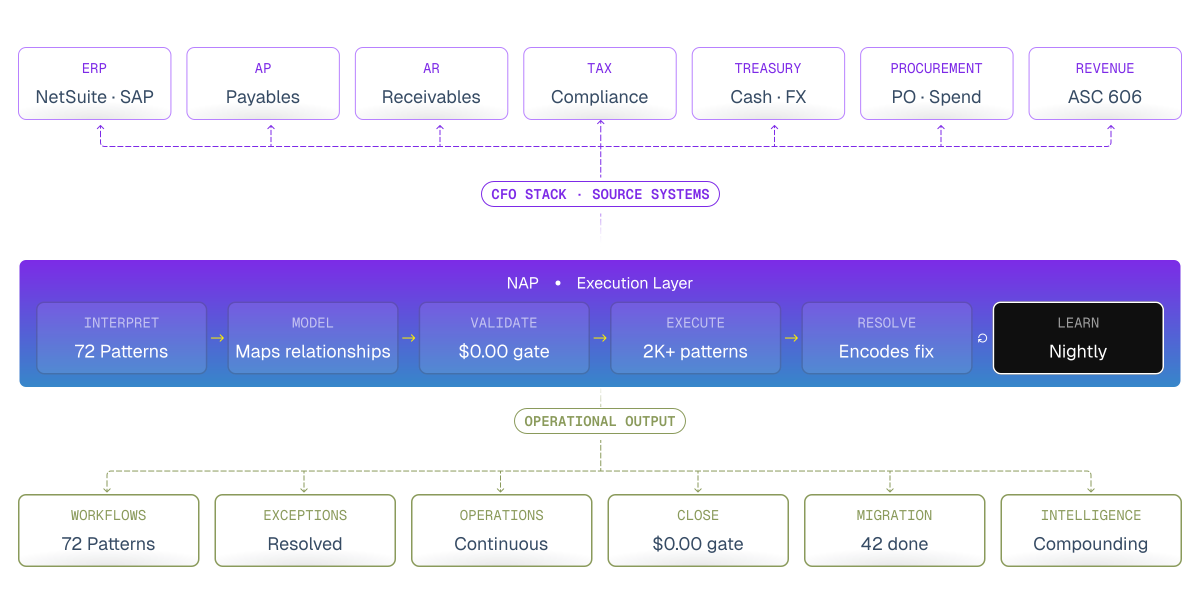
The system interprets your stack, models the relationships, validates correctness, executes workflows, resolves exceptions, and learns from every run — continuously, in production. 95% is deterministic code. Intelligence activates only where judgment is required.
Reads your ERP schema and generates the complete execution architecture automatically. QA'd at 94.5% across 42 deployments. No intake documents. No discovery workshops.
95% of all execution runs as deterministic code — governed, auditable, and reproducible. Every action logged. Every decision traceable to its source.
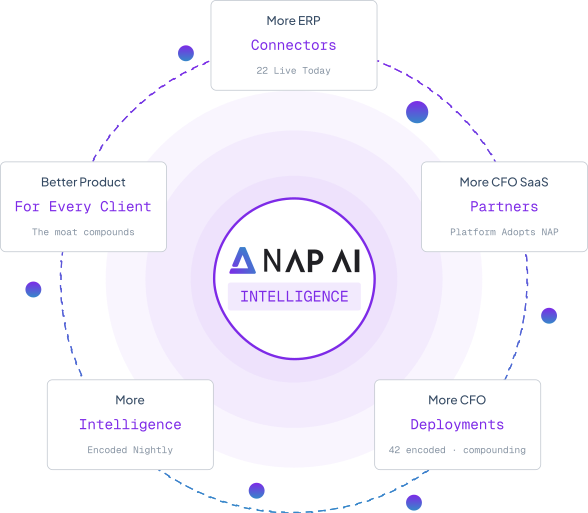
Every execution feeds back into the system overnight. Failure patterns encode automatically. Every deployment makes every subsequent deployment faster.

2K+ failure modes encoded across 30+ enterprise systems. The system already knows what breaks before the first record syncs. Bidirectional, auditable, self-monitoring from day one.
NetSuite, Sage, SAP, Oracle, Coupa, QuickBooks, Workday, and 15 more. Every connector pre-tested against the most common failure modes for that source system.
AP workflows vary by industry. A manufacturing client running 3-way match + bill-of-lading is fundamentally different from a SaaS company on ASC 606 revenue schedules. NAP encodes both.
Sync is never a one-time event. The connection monitors itself, detects drift, and surfaces anomalies — AP, AR, GL, Close, Tax, Treasury, Procurement, Revenue.

Already encoded from real deployments across 10 verticals. Not templates — learned patterns from 42 live environments. The system runs them continuously, handles exceptions automatically, and improves every night.
When a workflow hits an edge case, the system doesn't create a ticket. It identifies the failure pattern, applies the closest known resolution, and surfaces it for approval if needed.
Every workflow run is observed. Drift, anomalies, and failures surface automatically. The system detects when something is starting to break before it does.
276,000+ executions managed by a single engineer. Not because it's simple — because the system handles what would otherwise require a permanent team.

The same failure modes appear on every deployment. NAP has seen all of them — and encoded the resolution before your migration starts. Most finance automation continues running while correctness degrades. NAP resolves and encodes so failures never repeat.
When an exception appears, the system identifies the failure pattern, applies the known resolution, and encodes the outcome. The next time it appears — across any client — the system handles it automatically.
42 deployments. 10 verticals. 1,020+ blueprint questions. 2K+ failure modes. Every resolution becomes encoded knowledge that improves every subsequent deployment.
The system doesn't just detect obvious failures. It tracks correctness over time — detecting the slow fragmentation that causes 3-week close delays and 1,200-invoice reconciliation backlogs.

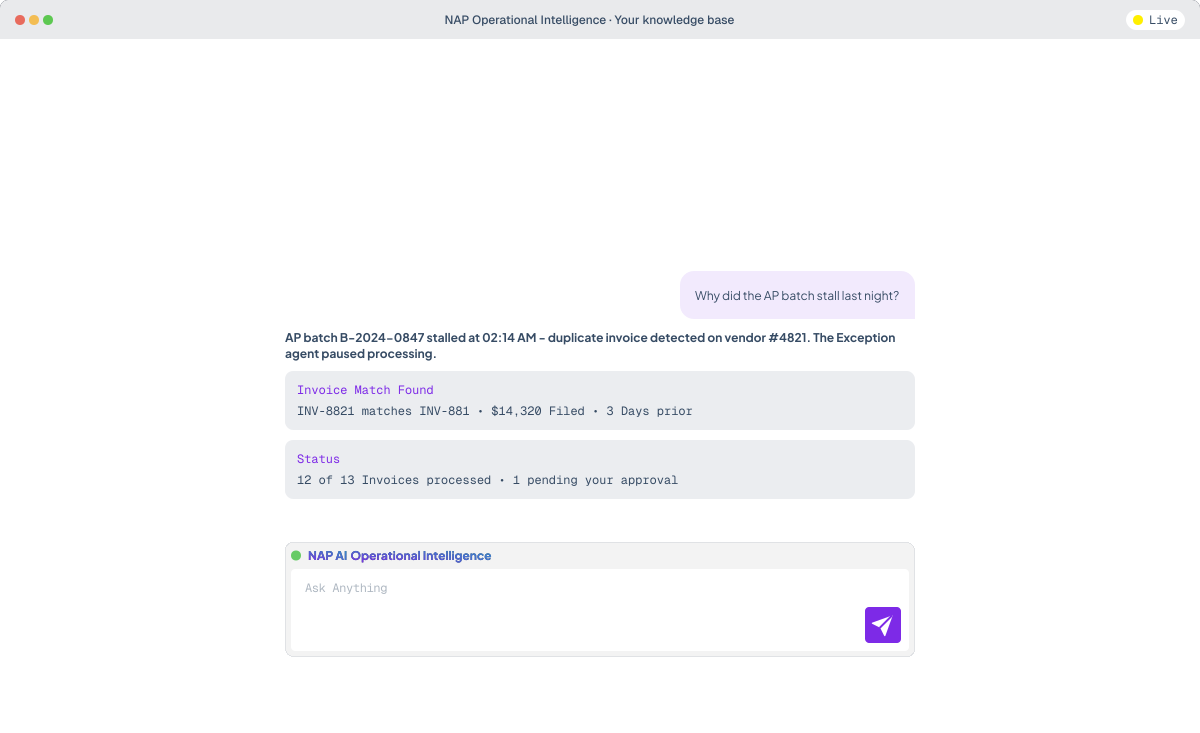
Operational intelligence built on your own forensic knowledge base — not generic AI. The system knows your AP workflows, your entity structure, your vendor rules. It surfaces what's happening and fixes what breaks.
Not a general-purpose assistant. Answers are grounded in your actual ERP configuration, your entity hierarchy, your historical execution patterns. It knows the difference between how the system was designed and how it actually runs.
"Fix the AP batch" isn't a question — it's an instruction. The system resolves, encodes the pattern, and confirms. This will not happen again.
Every execution is observed. The knowledge base updates nightly. Questions about AP, close, exceptions, or vendor issues are answered against the current state of the system — not a snapshot.

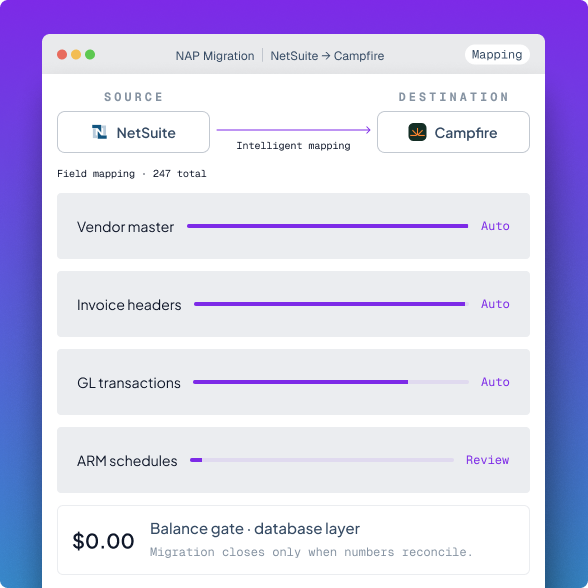
ERP-to-ERP data migration. The system doesn't start from configuration — it starts from prior deployments. 87% of fields auto-resolve by migration 3. Nothing posts until every entity reconciles to $0.00 at database layer.
Not a general-purpose assistant. Answers are grounded in your actual ERP configuration, your entity hierarchy, your historical execution patterns. It knows the difference between how the system was designed and how it actually runs.
"Fix the AP batch" isn't a question — it's an instruction. The system resolves, encodes the pattern, and confirms. This will not happen again.
Every execution is observed. The knowledge base updates nightly. Questions about AP, close, exceptions, or vendor issues are answered against the current state of the system — not a snapshot.